

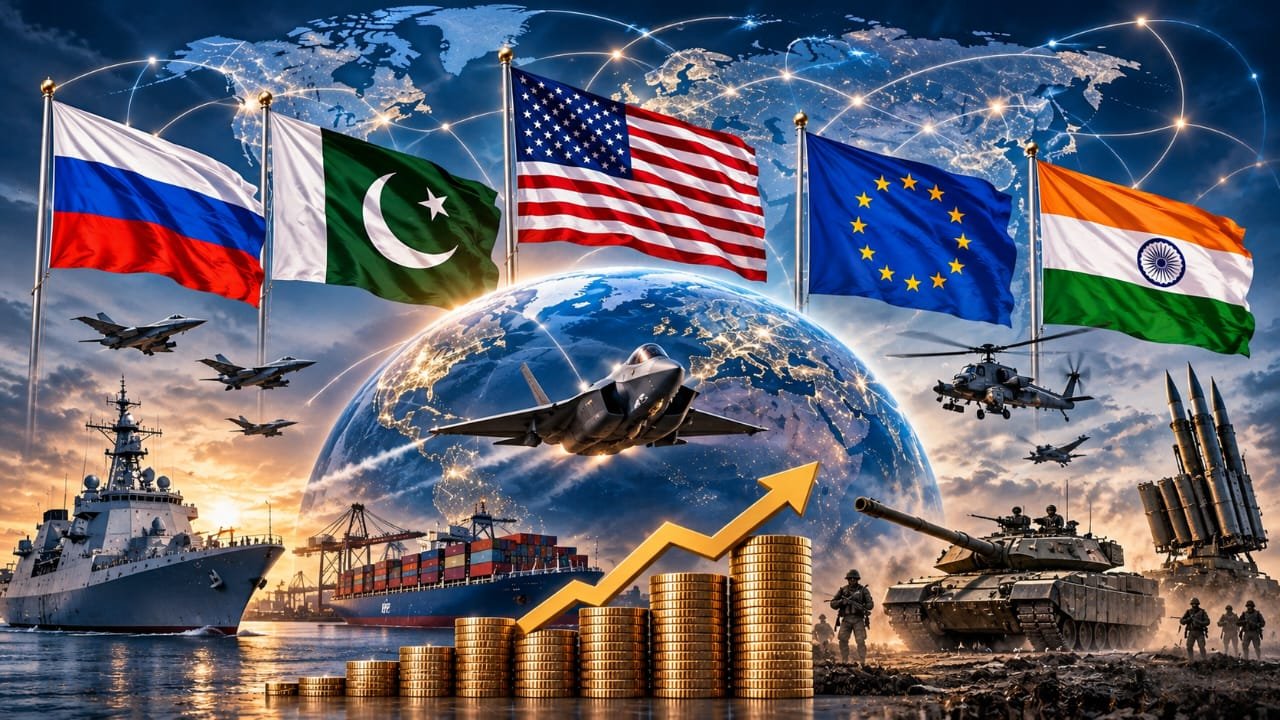
Geopolitics and international trade policies are becoming intertwined.International trade is increasingly influenced by geopolitical considerations rather than pure economic benefits. In a more fractious and fragmented world,people are making or choosing their economic partners with geopolitical consideration rather than pure or genuinely economic advantages meaning strategic considerations about who to trade with are growing rapidly. Let’s deconstruct how geopolitical developments impact global or regional trade policies and development.
Bone of contention between America and Russia over the deadliest battle in Ukraine and surging role of geopolitical considerations.
In 2025, the US under the “President of Donal Trump” placed enormous pressure on India to curtail its huge reliance on cheap Russian oil for its energy security. The direction was imposed as a blueprint to halt Russian war expeditions in Ukraine.Yet, Russia, Ukraine’s devastating confrontation since 2022 transparently revealed the tremendous surge of energy costs in the European market. This prolonged battle has shaped economic policies of the European Union by purging its dependency on Russia’s 40% exported LNG through Nord stream gas pipelines under the Baltic sea and diversified its economic policy toward the US for European energy security at the cost of 6th times higher energy for its socio economic stability.Hence,this contemporary scenario of exchange of commodities or energy trade with geopolitical observation conspicuously sheds light on the significance of geopolitical considerations in global economic policies or commerce rather than purely economic benefits.
Russia, Ukraine war triggers countries to re-evaluate its food security policies.
Ukraine is considered the foodbasket of Europe. Ukraine’s high capacity to ensure food security particularly in “Europe” is an undeniable fact.Russia’s military intervention in Ukraine in 2022 sent a pernicious shockwave through the global community to reassess their policies regarding food security because military confrontation surged wheat prices by 50% within a week of the war. The fragile development can be exemplified by the case in the realm of the country,Pakistan that already struggled with food deficiency. Pakistan has had heavy reliance on Ukrainian imported wheat to meet its food deficit. The exercise of military might between Ukraine and Russia,overlooking diplomacy as a durable and implementable blueprint badly impacted not only Pakistan’s food security in terms of the import bill but also that of others.Thus,the volatile picture of military combat and its repercussions on food security of countries dependent on Ukrainian export of good highlighted the significance of geopolitical considerations in shaping trade policies.
Iran – US- Israel joint aggression in 2026 provoking the international community to rethink its energy trade policies.
The blockade of the strategically crucial trade route the Strait of Hormuz. For the first time in history, conflict gave a second thought to global traders to reduce dependence on one route and diversify their trade destination. US – Israel geopolitical rivalries in West Asia against Iran and its Axis of Resistance,including the Iran-aligned Yemeni Houthi movement, which Tehran denies backing will always influence global energy trading because war has exposed the looming threat to the indispensable global maritime trade waterways Strait of Hormuz and Red sea. These unfavourable geopolitical events conspicuously reveal how geopolitical considerations are emerging as mandatory norms while formulating policies where, how and whom to trade with.
US, unilateral reckless sanctions on Cuba, Iran and Russia and others countries.
These all US, irrational series of sanctions on Cuba, Iran and Russia, also elevated the influence of geopolitical consideration in making international trade policies; for instance, the oil embargo on Cuba discouraged the global investor to spend money in Cuba. So in that way, it unveils the significance of geopolitical consideration while making economic investment.
Geopolitical considerations in the defence sector.
The geopolitical considerations are central to the defense sector.Military power isn’t just about weapons and financial gain. It’s about where, why and against whom these ammunitions may be used. The age of bloc politics,exemplified by Cold War military alliances, included; SEATO, CENTO, NATO and in contemporary scenarios like Pakistan-Saudi-Turkey trilateral collective security architecture stretching from South Asia to West Asia and Europe. These sorts of developments, from the Cold War to contemporary times,have widened the role of geopolitical considerations in the area of defence. There are exemplary cases that transparently reflect how deeply the geopolitical considerations have penetrated in the defense sector far beyond financial gain. Have a close look at the case study in the context of Pakistan-US transactional relationship. The US’s supply of its modern fighter aircraft F16 to Pakistan during War on Terror following 9/11,with restrictions on using these jets against India,which has been strategically aligned with America compelled the high authorities sitting in Islamabad to re-evaluate their security measures which resulted in the diversification of policy toward China’s technological superiority in the domain of defence.Pakistan’s entire defence strategy is built on the perception of threat by its eastern aggressive neighbor, India. According to Stockholm International Peace Research Institute (SIPRI),Pakistan imports 80% of its major arms from China. And China’s unrestricted support and supply of military technology to Pakistan for use against India indirectly illuminates how mutual threat from regional rivals have promoted the geopolitical considerations in the defense sector cooperation between China and Pakistan and deprived India of China’s growing technological capabilities.
EU’s security concerns about Russia.
European nations,especially those affiliated with NATO, by and large avoid purchasing military equipment from Russia,one of top global arms producers in the world after the US and China, not necessarily Russia, lacks technological superiority, but because purchasing such equipment would grow EU’s strategic dependence or would come with greater restrictions about weapons where,why, and against whom the weapons can be used. This is how geopolitical considerations influence the states’ policies in each and every sphere of state affairs.
No space for neutrality in geopolitics.
The offshoots of geopolitical development not only shape economic policies, investment, disturb socio-economic security, regional sustainable development initiatives, but also,constrain neutrality and balancing approach in foreign policy.The intensifying geopolitical events in the age of emerging multilateralism has deprived nations of the ability to take a neutral stance in the face of any political developments due to their economic and security dependencies shared strategic interests or fear of trade restrictions with their respective partners.The surging role of geopolitics has penetrated in depth that it has left no room for the foreign policy of any political actor to remain unspoken. One has to take a side, otherwise it severs the nation’s relations with its strategic partners.
The geopolitical considerations have emerged as an important norm in global politics. The avoidance of geopolitical considerations in the decision-making process can affect the respective actor in both positive and negative ways. A series of contemporary case studies such as the Russia-Ukraine war, the US-Israel mutual horrific and horrendous war policies in the Middle East against Iran. Moreover, China’s rise as an economic giant. Mutual defence agreement among countries all require strong political considerations and any action without assessing the role of geopolitics can prove fatal because every trade relationship or strategic alignment has become politicized.
Sign in to add a private note to this story.

Related Stories
Pakistan’s Political culture: From statehood to Political participation.
Political culture refers to the beliefs, values, attitudes, and expectations that shape citizens’ relationship with the state and…

Economics Behind Armed Conflict in Iran
When two countries are at a state of tension where there is use of weapons, that causes destruction…