


Flydubai FZ1073 from Dubai to Tel Aviv made an emergency landing in Saudi Arabia after a cockpit attack. Here are six major unanswered questions surrounding the incident.
Flydubai FZ1073: 6 Questions Raising Doubts About the Official Narrative
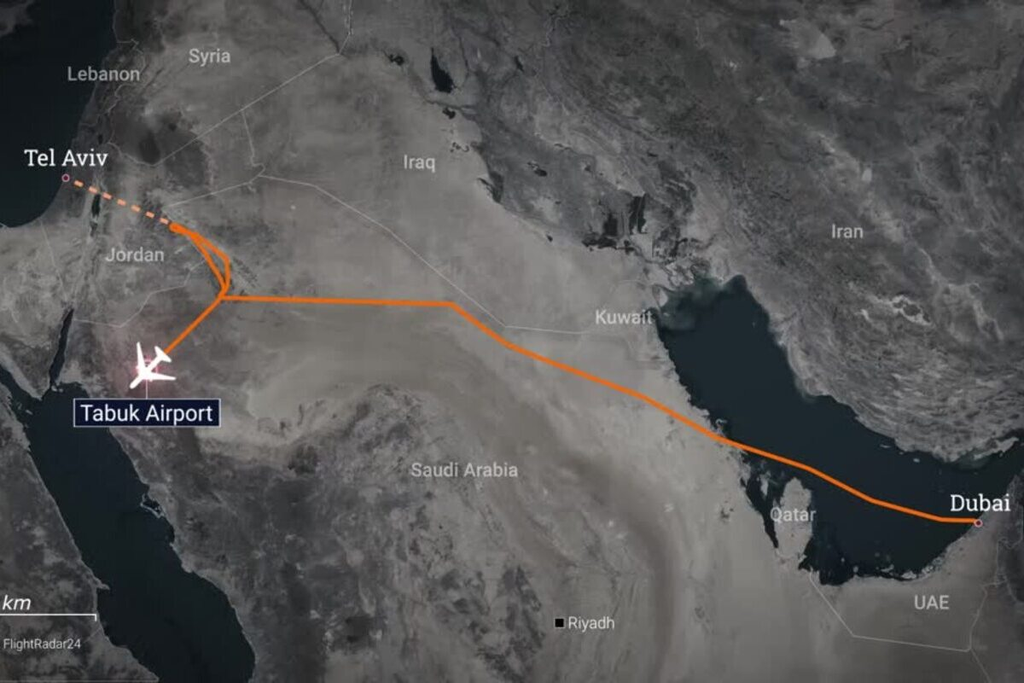
On September 30, 2026, flydubai flight FZ1073, travelling from Dubai to Tel Aviv with more than 170 people on board, suddenly lost thousands of feet in altitude before diverting to Tabuk, Saudi Arabia.
Israeli officials say the Omani co-pilot attacked the Indian captain and apparently tried to crash the plane. The injured captain reportedly unlocked the cockpit door, allowing passengers and reserve crew members to overpower the attacker and regain control.
The UAE, however, says the investigation is still examining the motive, possible terrorist connection, prior planning and whether anyone directed the attacker.
This has left several important questions unanswered.
1. Why Was an Israel-Bound Flight Freely Crossing the Region While Iranian Aviation Is Being Restricted?
This incident happened at a time when Iranian civil aviation is under extraordinary international pressure.
The restrictions originate mainly from new U.S. sanctions against Iranian airlines and companies providing them services. Washington warned businesses and aviation service providers that dealing with Iranian carriers could expose them to secondary sanctions. Following those measures, Iranian flights were suspended across several regional and neighbouring markets. The UAE suspended Iranian airline operations, while Iraqi airports also halted Iranian flights, and routes involving Oman, Georgia and Azerbaijan were disrupted.
This creates an important regional contrast: an aircraft carrying mostly Israeli passengers was able to cross Gulf and Arab airspace towards Israel while Iranian civilian aviation was being progressively isolated because countries and aviation companies were responding to U.S. sanctions.
Why has the region broadly implemented restrictions created by U.S. sanctions against Iranian aviation while aviation links serving Israel continue to operate?
2. Could Israel Politically Benefit From the Incident?
The incident also happened during a period of intense international criticism of Israel over Gaza.
Because the aircraft was carrying mostly Israelis and the alleged attacker was an Arab Muslim co-pilot, some commentators have questioned whether the incident could ultimately help Israel present itself again as the victim of terrorism and regain international sympathy.
Netanyahu officially said was that the co-pilot apparently tried to crash the aircraft and that the passengers and crew who intervened had prevented a “huge disaster.”
3. How Did the Cockpit Story Actually Unfold?
Modern cockpit doors are heavily secured.
According to the current Israeli account, the injured captain somehow managed to unlock the cockpit door from inside, after which passengers and crew entered and restrained the co-pilot. Reuters has reported the same basic sequence.
But investigators still need to establish the exact second-by-second sequence:
When was the captain attacked?
When did the aircraft begin its rapid descent?
When was the door unlocked?
Who entered first?
And when did the reserve pilots regain control?
These details matter because the aircraft reportedly lost roughly 14,000 feet in a very short period.
4. Where Did the Weapon Come From?
Another major question concerns the weapon.
Initial Israeli accounts described the captain being stabbed.
If a prohibited knife was brought onto the aircraft, investigators need to explain how it passed airport and crew security.
If, alternatively, a cockpit emergency tool was used, that would create a very different security scenario.
Until investigators identify the exact weapon and how it was obtained, this remains one of the most important unanswered questions.
5. Why Did the Plane Land in Tabuk Instead of Jordan?
Flight-tracking data showed the aircraft approaching and briefly entering the Jordanian area before turning back towards Saudi Arabia.
Yet instead of landing at a Jordanian airport, the aircraft headed to Tabuk.
Saudi authorities say the flight made a distress call and specifically requested an emergency landing there. There is currently no evidence that Jordan refused permission or that Saudi Arabia forced the aircraft to land in Tabuk.
Still, the choice deserves explanation in the final investigation.
Tabuk also carries major historical significance for Muslims. In 9 AH / 630 CE, Hazrat Muhammad ﷺ led the expedition of Tabuk towards the Byzantine frontier. No major battle ultimately took place, but the expedition strengthened the Muslims’ strategic position in northern Arabia.
There is no evidence that the modern flight was deliberately diverted to Tabuk because of this historical connection, but the location has naturally attracted attention because of its symbolism.
6. Why Was It Called a “Jihadist Terror Attack” Before the Investigation Was Finished?
Israeli officials quickly described the incident in ideological terms.
Netanyahu has since said the co-pilot may have undergone Islamist radicalisation, while Israel’s defence leadership characterised the incident as terrorism. But as of October 1, investigators had not publicly established a final motive.
The UAE investigation is specifically examining whether terrorism, prior planning or outside direction were involved.
That means the final label should come after the evidence, not before it.
The Black Boxes Can Answer the Biggest Questions
The strongest evidence will come from the aircraft itself.
The Cockpit Voice Recorder (CVR) can establish what was said and heard inside the cockpit.
The Flight Data Recorder (FDR) can reconstruct altitude, speed, control inputs and the aircraft’s movements.
Investigators can also examine ATC communications, cockpit-door access data, passenger videos and any available surveillance recordings.
If the investigation is transparent, these records should allow authorities to reconstruct the incident accurately.
Was It a False Flag?
There are legitimate questions about the cockpit sequence, the weapon, the diversion to Tabuk, the suspect’s motive and the speed with which political conclusions were announced.
The strongest approach is therefore not to declare the case solved in either direction.
The evidence should answer the questions.
Who attacked the captain? Why? How was the weapon obtained? Why was Tabuk selected? What do the CVR and FDR show? And was anyone else involved?
Until those findings are released, the distinction between confirmed fact, official allegation and political interpretation remains essential.
Sign in to add a private note to this story.

Muntzir Mahdi
Journalist, digital content creator, and host dedicated to investigative storytelling and geopolitical analysis. I specialize in producing high-quality documentaries and programs that explore global conflicts and the hidden facts behind international events.
View all stories →Related Stories

The Real War: Truth Against Falsehood
Today’s war is not a war of sects. It is not a Shia–Sunni war. It is not a…

Pakistan’s Child Abuse Crisis: A Disease Beneath the Surface
According to the Ministry of Human Rights, 17,771 cases of rape and gang rape against women were reported…

You never thought that they would leave.
﴿مَا ظَنَنْتُمْ أَنْ يَخْرُجُوا﴾ This is part of the second verse of Surah Al-Hashr, in which Allah, the…