

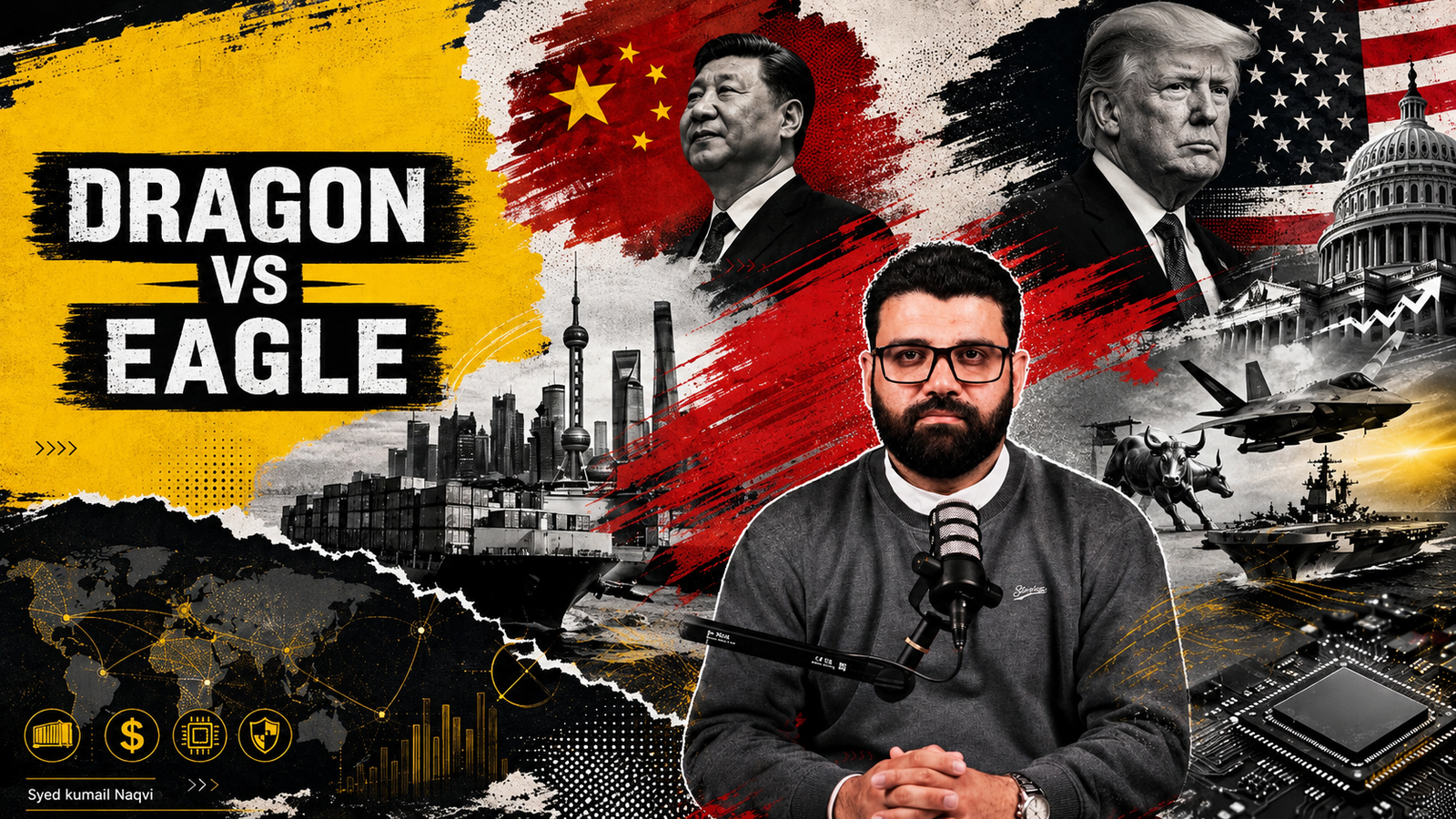
How China and America Went From Cold War Enemies to Economic Partners — and Strategic Rivals
For nearly half a century, the relationship between the United States and China has shaped the global economy, military balance, and technological future of the world. What began as a Cold War standoff evolved into one of the deepest economic partnerships in modern history — only to transform once again into a fierce strategic rivalry.
Today, the tensions between Washington and Beijing influence everything from semiconductor production and artificial intelligence to military alliances and global trade routes. Understanding how this relationship evolved is essential to understanding the modern world itself.
From Revolution to Isolation
Modern China–America relations began in 1949, when Mao Zedong and the Chinese Communist Party emerged victorious in the Chinese Civil War and established the People’s Republic of China.
The defeated Nationalist government, led by Chiang Kai-shek, retreated to Taiwan — setting the stage for one of the world’s most enduring geopolitical disputes.
The United States sided with Taiwan during the early Cold War years, viewing communist China as part of the broader Soviet-led communist bloc. Relations deteriorated further during the Korean War, where American and Chinese troops fought directly against one another.
For more than two decades, Washington refused to recognize the government in Beijing, instead treating Taiwan as the legitimate government of China.
At the time, China was economically weak and internationally isolated. Few could have predicted that it would one day emerge as America’s principal strategic competitor.
Nixon’s Gamble Changed the World
Everything changed in 1972.
In one of the most dramatic diplomatic moves of the Cold War, President Richard Nixon traveled to Beijing and met Mao Zedong. Although Nixon was known for his staunch anti-communism, he saw an opportunity to exploit growing tensions between China and the Soviet Union.
The visit resulted in the historic Shanghai Communiqué, where the United States acknowledged the “One China” policy while maintaining unofficial ties with Taiwan. The carefully crafted ambiguity surrounding Taiwan would remain central to U.S. policy for decades.
Formal diplomatic relations between Washington and Beijing were established in 1979 under President Jimmy Carter.
Soon afterward, Chinese leader Deng Xiaoping launched sweeping economic reforms that opened China to foreign investment and international trade. American businesses quickly recognized the potential of China’s massive labor force and consumer market.
Factories multiplied across coastal China, marking the beginning of one of the fastest economic transformations in human history.
Economic Cooperation — Despite Political Tensions
The partnership was never entirely smooth.
In 1989, pro-democracy protests erupted in Beijing’s Tiananmen Square. The Chinese government’s violent crackdown shocked the international community and temporarily strained relations with the United States.
Yet economic cooperation continued to deepen.
During the 1990s, American companies increasingly shifted manufacturing operations to China, attracted by low labor costs and expanding industrial capacity. China became known as “the factory of the world.”
The arrangement benefited both countries in different ways. American consumers enjoyed cheaper goods, while China experienced extraordinary economic growth and lifted hundreds of millions of citizens out of poverty.
However, the relationship also produced growing anxieties in the United States, where many manufacturing communities suffered job losses tied to globalization and foreign competition.
China’s WTO Entry Accelerated Globalization
China’s entry into the World Trade Organization in 2001 transformed the global economy.
Membership in the WTO opened international markets to Chinese exports and encouraged a flood of foreign investment. Chinese manufacturing expanded at breathtaking speed, while multinational corporations became deeply dependent on Chinese supply chains.
Companies such as Apple, Walmart, and Nike built major portions of their production systems around Chinese factories.
Meanwhile, China accumulated enormous foreign currency reserves and became one of the largest holders of U.S. Treasury bonds.
Economists began referring to the relationship as “Chimerica” — a deeply interconnected economic system in which American consumers and Chinese manufacturers became mutually dependent.
For a time, many policymakers believed economic integration would eventually reduce political tensions.
They were wrong.
The Shift Toward Strategic Competition
As China’s economy expanded, so did its military and geopolitical ambitions.
Beijing rapidly modernized its armed forces, expanded its naval presence, and asserted territorial claims in the South China Sea by building artificial islands and military facilities in disputed waters.
Washington responded with military patrols and growing concern about China’s long-term intentions.
At the same time, accusations of cyber espionage and intellectual property theft intensified. Human rights issues — including Xinjiang, Hong Kong, censorship, and surveillance — became increasingly contentious points in bilateral relations.
The arrival of Xi Jinping as China’s leader in 2012 marked another turning point.
Under Xi, China adopted a far more assertive foreign policy. Initiatives such as the Belt and Road Initiative expanded Chinese infrastructure and investment projects across Asia, Africa, Europe, and beyond.
To many American policymakers, China no longer appeared to be simply a rising economy. It looked increasingly like a global superpower seeking to reshape international influence.
The Trade War and the Technology Battle
The rivalry entered a new phase in 2018, when President Donald Trump launched a trade war against China.
The Trump administration accused Beijing of unfair trade practices, forced technology transfers, currency manipulation, and intellectual property theft. Tariffs were imposed on hundreds of billions of dollars’ worth of Chinese goods, triggering retaliation from Beijing.
The conflict soon spread beyond trade into technology.
Washington imposed restrictions on Chinese technology companies such as Huawei and tightened controls on advanced semiconductor exports. The United States increasingly viewed control of critical technologies — especially semiconductors and artificial intelligence — as a matter of national security.
Modern chips power everything from smartphones and AI systems to military hardware and supercomputers. As a result, semiconductors became central to the geopolitical contest between the two countries.
China responded by investing heavily in domestic chip manufacturing and pursuing technological self-sufficiency.
The relationship had evolved from economic competition into a broader struggle over technological and strategic dominance.
Taiwan: The Most Dangerous Flashpoint
No issue poses greater danger in China–America relations than Taiwan.
China considers Taiwan a breakaway province that must eventually reunify with the mainland. The United States officially recognizes the “One China” policy but maintains close unofficial ties with Taiwan and continues selling defensive weapons to the island.
Washington’s policy of “strategic ambiguity” deliberately avoids clearly stating whether the United States would intervene militarily in the event of a Chinese attack.
Tensions have escalated in recent years through military exercises, naval deployments, and high-profile political visits.
Taiwan’s importance extends far beyond geopolitics.
The island is home to Taiwan Semiconductor Manufacturing Company (TSMC), the world’s leading producer of advanced semiconductors. These chips are essential for companies such as Apple, Nvidia, and AMD — and for the functioning of the global digital economy itself.
Any conflict over Taiwan could trigger worldwide economic disruption on an unprecedented scale.
A New Cold War — But Different
Today, many analysts describe the U.S.–China rivalry as a “New Cold War.”
Yet unlike the Cold War with the Soviet Union, the two economies remain deeply interconnected.
The modern competition revolves around artificial intelligence, quantum computing, cybersecurity, advanced manufacturing, and global political influence.
The United States continues to restrict China’s access to cutting-edge AI chips and semiconductor technology, while China invests aggressively in domestic innovation and strategic industries.
Meanwhile, companies worldwide are diversifying supply chains toward countries such as India, Vietnam, and Mexico in an effort to reduce dependence on Chinese manufacturing.
Despite these shifts, complete economic separation between the two powers remains unlikely in the near future. The ties between them are simply too extensive.
The Relationship That Will Define the Century
The relationship between China and the United States is no longer simply a bilateral issue. It is the central geopolitical story of the 21st century.
The outcome of this rivalry will shape global trade, technological innovation, military stability, artificial intelligence, and the future balance of power itself.
The dragon and the eagle are now locked in a competition neither side can easily escape — and the rest of the world is watching closely.
Conclusion: A Rivalry Shaping the Future
The story of China and America is no longer just about two nations. It is about the future of the global economy, military power, technology, and the international order itself.
The central question now is whether Washington and Beijing can manage their competition without allowing it to spiral into open conflict.
Will the two powers choose cooperation on trade, climate, and global stability?
Or will strategic rivalry deepen into a more dangerous confrontation over technology, influence, and Taiwan?
The answer may determine the course of the 21st century.
Because when the Dragon and the Eagle collide, the consequences are felt far beyond Beijing and Washington ,they are felt across the entire world.
Sign in to add a private note to this story.

Related Stories
The Real War: Truth Against Falsehood
Today’s war is not a war of sects. It is not a Shia–Sunni war. It is not a…

You never thought that they would leave.
﴿مَا ظَنَنْتُمْ أَنْ يَخْرُجُوا﴾ This is part of the second verse of Surah Al-Hashr, in which Allah, the…

Freedom – what does it mean?
Freedom – what does it mean? Is freedom something that comes in stages, or is it a definitively…