

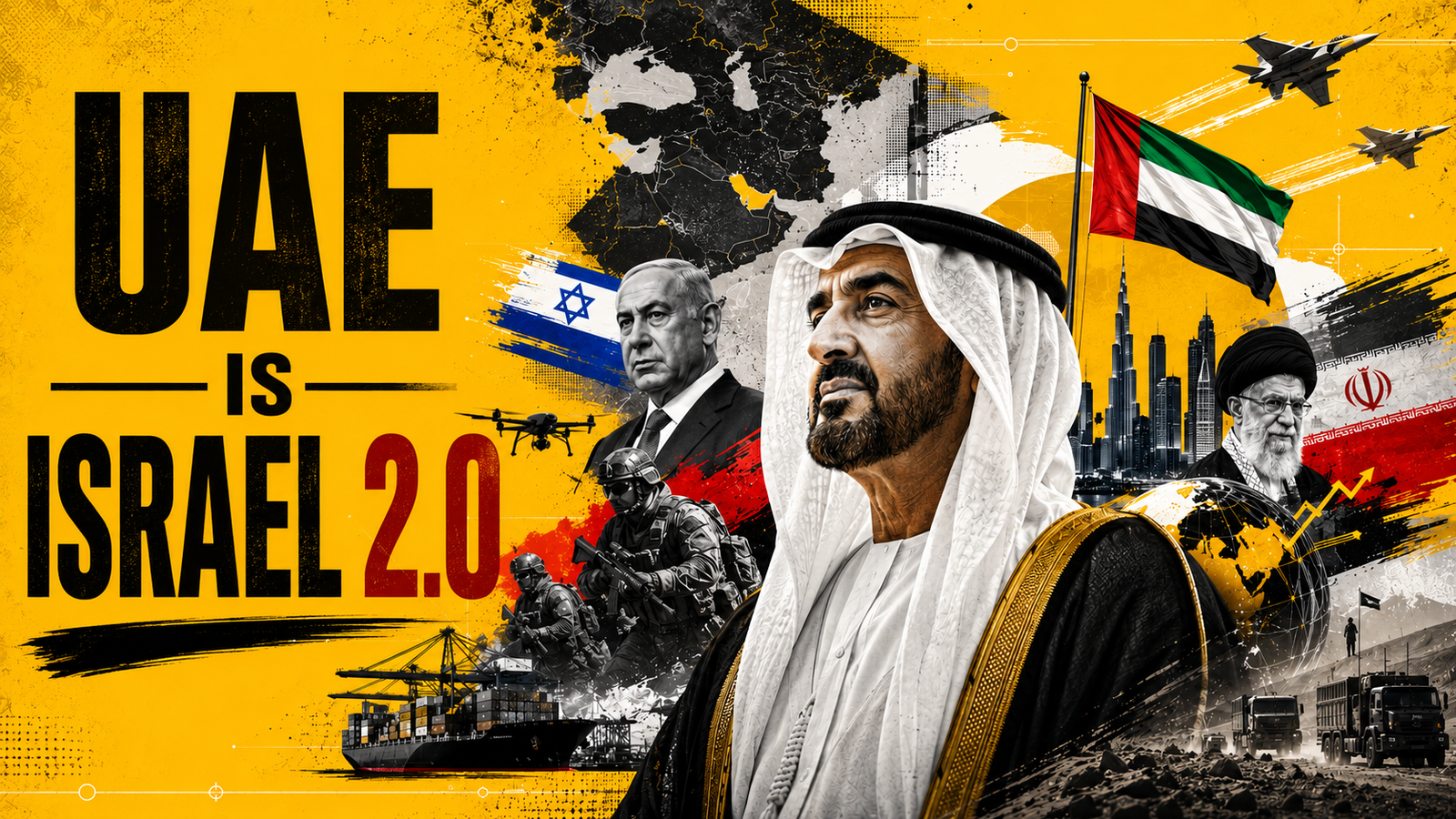
What if I told you that a small desert country younger than several Hollywood actors has become one of the most influential powers in the Middle East?
The United Arab Emirates.
A country famous for luxury hotels,futuristic skyscrapers, and billions of dollars in tourism.
But behind Dubai’s glittering image lies a much bigger reality.
This is a state deeply involved in Middle Eastern politics,diplomacy, intelligence, regional conflicts, and global trade.
From normalizing relations with Israel, to military operations in Yemen, to allegations surrounding Sudan’s civil war, to maintaining a careful balance with Iran , the
UAE has transformed itself from a quiet Gulf federation into a full-blown geopolitical power.
So how did all of this happen? And what does the UAE actually want in the Middle East?
Part 1 — The Formation of the UAE
Before oil, the Gulf was a poor region. The area that is today the UAE had an economy that depended mostly on pearl diving, fishing, and desert trade. For centuries, local tribes ruled small coastal settlements —
Abu Dhabi,Dubai, Sharjah, and Ras al-Khaimah.
And beyond trade, piracy was also a major source of income. If you look at old maps, this coastline was literally called the “Pirate Coast.”
In the 1800s, Britain signed treaties with these rulers to secure maritime trade routes to India. The territories became known as the Trucial States.
Everything changed when oil was discovered in Abu Dhabi in the1950s.
Then in 1971, Britain withdrew from the Gulf. Seven emirates united under the leadership of Sheikh Zayed bin Sultan Al Nahyan to form the UnitedArab Emirates.
Within just a few decades, the UAE went from desert settlements to one of the wealthiest countries on earth. Oil money funded infrastructure,education, ports, airlines, financial systems, and ultimately global influence.Cities like Dubai and Abu Dhabi became symbols of modernity and global capitalism. But economic success was only the beginning.
Part 2
The UAE’s Role in the Middle East
For many years, the UAE stayed away from major political confrontations. But after the Arab Spring in 2011, everything changed.
The Arab Spring terrified Gulf monarchies. Governments across the Middle East were falling. Protests were spreading. And Islamist movements like the Muslim Brotherhood were gaining power. The UAE’s leadership saw this as a direct threat to regional stability and to their own monarchy. So Abu Dhabi began adopting a far more aggressive foreign policy.
Its strategy came to revolve around three core goals:
fighting political Islam, particularly groups linked to the Muslim Brotherhood;expanding economic and naval influence, especially around the Red Sea and the Horn of Africa; and countering Iran’s regional influence while still maintaining economic ties with Tehran.
Some analysts describe the UAE as a “small state with big ambitions.”
And the clearest example of that can be seen in Yemen.
Part 3 —
The Yemen War and the UAE
In 2015, the UAE joined the Saudi-led coalition against the Houthi movement in Yemen. The Houthis are considered allies of Iran, and Gulf states feared Yemen would become another country under Iranian influence.
Initially, Saudi Arabia and the UAE worked closely together — but over time their goals began to diverge. Saudi Arabia was mostly focused on preserving a unified Yemen, while the UAE’s attention was on southern Yemen, keyports, anti-Islamist factions, and naval control near the Red Sea. The UAE backed southern separatist groups like the Southern Transitional Council (STC).
The Yemen war became one of the worst humanitarian crises in the world. And it made one thing very clear the UAE was no longer just the Gulf’s business hub.
It had become an interventionist regional power.
Part 4
The UAE, Sudan, and African Influence
The UAE’s reach now extends well beyond the Middle East into Africa.Sudan became particularly important because of what it offers:
access to the Red Sea, agricultural resources, gold, and military partnerships.
In recent years, the UAE has been accused of supporting the Rapid Support Forces (RSF) in Sudan’s civil war. The UAE denies these allegations.However, multiple international reports and analysts have linked Abu Dhabi to networks connected to armed groups operating in Sudan.
One thing is clear:
the UAE has become deeply embedded in the geopolitics of the Red Sea and East Africa.
Part 5
The UAE and Israel
Perhaps the most significant diplomatic shift came in 2020, when the UAE normalized relations with Israel under the Abraham Accords.
This move shocked much of the Arab world.
For decades, most Arab countries had refused to establish full relations with Israel without the creation of a Palestinian state.
So why did the UAE normalize?
Shared concerns about Iran both saw it as the major regional threat. Economic opportunities in technology, cyber security, AI, tourism, agriculture,and defense. And stronger ties with Washington the deal also cemented the UAE’s relationship with the United States.
Today the UAE is trying to maintain a difficult balance: keeping ties with Israel, giving verbal support to Palestinians, and protecting its regional partnerships.
But it is not that simple.
Some analysts believe Israel’s involvement in the UAE goes back to its very founding in 1971 through business circles and individuals , because Israel needed an economic hub from the beginning, and chose this land partly because of its own status as a contested country.
One striking sign of this
is how Israel defended the UAE during the recent war , something that had never happened before in the world. And how Iran launched retaliatory strikes on the UAE was equally remarkable.
This is why you sometimes come across the phrase: “The United Arab Emirates —Israel 2.0.”
Part 6
The UAE and Iran
The UAE opposes Iran’s regional military influence but at the same time maintains economic and diplomatic ties with Tehran.
Why?
Because geography matters. Iran sits directly across the Gulf from the UAE.
And the UAE’s economy depends heavily on regional stability and maritime trade.
So the UAE’s Iran policy is simultaneously competitive and cautious.
And this balancing act is one of the main reasons the UAE has managed to protect itself through one regional crisis after another.
Part 7
UAE-Israel Defense
Integration: “Israel 2.0”
The Abraham Accords were not just signatures on paper. What has emerged since is far deeper and more concrete
a multi-layered defense and commercial framework linking the UAE and Israel at every level.
DP World, Dubai’s global port
operator, signed memorandums of understanding with Israeli businessman Shlomi Fogel’s company DoverTower. The goal was to develop Israeli ports and free trade zones, and to establish a direct maritime route from Eilat to Jebel Ali. A DP World subsidiary also signed a deal with Israeli firm Allalouf Logistics to explore new freight forwarding opportunities.
The UAE’s state defense company, Edge Group, bought a 30% stake in Israeli firm Thirdeye Systems for $10 million.
Thirdeye makes AI-based electro-optical systems that detect drones and unmanned aircraft a technology that is critically important given the Iranian drone threat in the Gulf.
In November 2024, Israeli company Elbit Systems signed a $2.3billion defense deal with an “unnamed international customer”spanning eight years.
According to Intelligence Online, that secret buyer was the UAE.
The deal included an upgraded version of the J-Music DIRCM system ,a laser-based jamming technology that disables heat-seeking missiles. It is one of the largest Israeli defense deals in history.
Then in February 2026, when Iran launched missile and drone strikes on Gulf states in response to joint Israeli-American attacks, Israel took a historic step:
for the first time ever, a complete Iron Dome battery was deployed in the UAE. It was the first time the system had been sent to any country other than Israel and the United States and Israeli military personnel were operating it on Emirati soil. The deployment also included the Spectro surveillance platform and Iron Beam alongside Iron Dome, and the system shot down dozens of Iranian missiles.
Saudi media reported in January 2026 that the
UAE was planning to build an Israeli military base near the Saudi border in an area called “Aradah,” which would house 800 Israeli soldiers.
Some analysts dismissed this as a Saudi propaganda campaign, but the report came at a time when UAE-Israel military cooperation was visibly growing.
Taken together, all of these developments paint
a clear picture:
the UAE is building a multi-layered defense structure connected to Israel through trade, technology, and now formal military cooperation.
The 2026 Iran conflict turned this quiet normalization into an open military alliance. Analysts say this is not just an emergency measure it is laying the foundation for a permanent regional air defense alliance that has moved from theory into operational reality.
Conclusion In just over fifty years, the UAE has transformed itself from a desert federation into one of the most influential states in the Middle East.
Today it is a financial hub, a military power, a diplomatic broker, and a strategic power player.
Supporters see the UAE as modern, pragmatic, and stability-producing.
Critics call it interventionist, authoritarian, and dangerously overextended abroad.
But whatever your view, one thing is absolutely clear:
the UAE is no longer a quiet Gulf monarchy sitting on the sidelines.
It is actively shaping the future of the Middle East. And as conflicts continue in Gaza, in Sudan, in Yemen, and around Iran , the UAE’s role will only grow more central. So the real question is this:
Is the UAE building stability in the Middle East… or building a new regional empire?
Sign in to add a private note to this story.

Related Stories
The Real War: Truth Against Falsehood
Today’s war is not a war of sects. It is not a Shia–Sunni war. It is not a…

You never thought that they would leave.
﴿مَا ظَنَنْتُمْ أَنْ يَخْرُجُوا﴾ This is part of the second verse of Surah Al-Hashr, in which Allah, the…

Freedom – what does it mean?
Freedom – what does it mean? Is freedom something that comes in stages, or is it a definitively…