

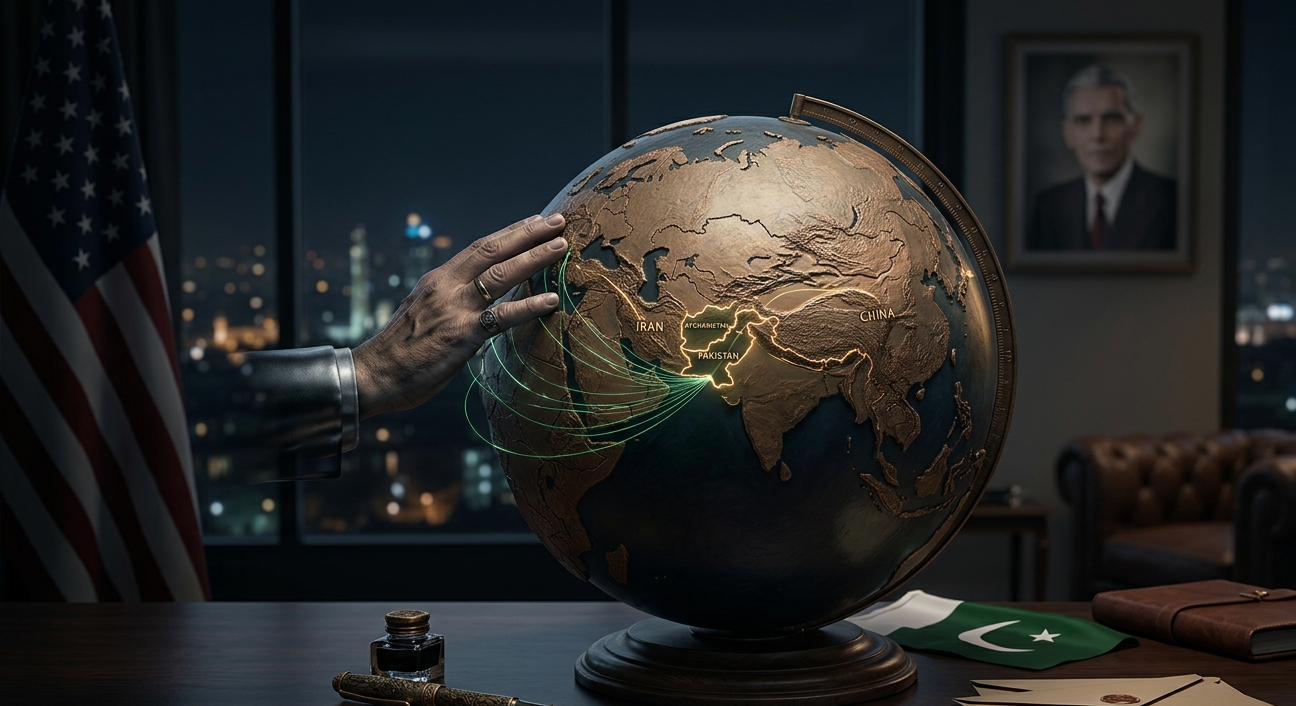
Pakistan seems to be standing at a highly sensitive crossroads of global politics once again. The only difference is that this time the battlefield is not Afghanistan but Iran, and the characters are the same—the US, the Middle East, backchannel contacts, mediation, and Pakistan. Ostensibly, it looks like Pakistan is playing a positive diplomatic role, but the question is: is history about to repeat itself?
In recent months, a perception has rapidly emerged that Pakistan is acting as a crucial coordinator between the United States and Iran. Various international reports suggest that messages between Washington and Tehran are being transmitted through Islamabad. Pakistani officials have also repeatedly stated that Pakistan is ready to play its role in defusing regional tensions and finding a diplomatic solution.
On the surface, all of this feels like a major diplomatic success for Pakistan. It seems as if Pakistan has once again become important in the eyes of global powers. But looking back at history, a question constantly revolves in the mind: hasn’t Pakistan played such “important roles” before? And what was the ultimate outcome of those roles?
The Alliances of the Cold War
During the Cold War era, Pakistan decided to side with the United States. In that era, Pakistan not only became part of American defense alliances like SEATO and CENTO but was also declared America’s most reliable ally in Asia. Pakistan provided key military facilities to the US, so much so that American spy planes used to monitor the Soviet Union from near Peshawar.
Pakistan was assured at the time that it was an indispensable ally for America. But during the 1965 war, when Pakistan needed practical support, the US announced arms sanctions. This was the first major shock for Pakistan. In Islamabad, a strong sense emerged that America’s friendship is tied to interests, not emotions.
The “Bridge State” Between US and China
Pakistan also played a historic role in restoring relations between America and China. During President Yahya Khan’s era, Pakistan established contacts between Washington and Beijing through secret diplomacy. Henry Kissinger’s secret visit to China was made possible only through Pakistan, which paved the way for US President Nixon’s historic visit to China.
This was considered a massive diplomatic breakthrough for Pakistan. The global media labeled Pakistan a “Bridge State.” But the irony is that during this very time, Pakistan itself was suffering from a severe internal crisis. East Pakistan broke away to become Bangladesh, while only formal statements of concern were heard from America. Practical help was nowhere to be seen.
It was somewhat like patching up a friendship between two people; they both become best friends, and later they remove you from the group chat.
The Afghan Jihad and Its Aftermath
Then came the Afghan Jihad. America made Pakistan a frontline state against the Soviet Union. Billions of dollars in aid, weapons, training, and intelligence cooperation—everything funneled through Pakistan. Pakistan hosted millions of Afghan refugees, allowed its territory to be used, and became part of a war that was heavily promoted as a “Jihad” at the time.
The Soviet Union eventually withdrew from Afghanistan, and America celebrated its victory. But what was left in Pakistan’s share?
- The Kalashnikov culture
- Drug trafficking
- A massive refugee crisis
- Extremism
- Economic Sanctions
In the 1990s, America imposed sanctions on Pakistan over its nuclear program. The same Pakistan that was the “most important ally” just a few years prior suddenly became the problem.
The history of relations between Pakistan and the US sometimes feels like that neighborhood friend who knocks on your door every day when they need something, but as soon as the job is done, they change their route just to avoid saying hello.
The War on Terror
Following the events of 9/11, the War on Terror began. America famously gave Pakistan an ultimatum: “You are either with us or against us.” General Pervez Musharraf decided to side with America. Pakistan provided military bases, shared intelligence, opened its airspace, and launched operations against militant groups.
Pakistan paid a heavy price for this war. Thousands of lives were lost, the economy suffered billions of dollars in losses, and an internal security crisis engulfed the country. Yet, when America abruptly withdrew from Afghanistan, Pakistan was once again left standing alone. The Abbottabad operation raised serious questions about Pakistan’s sovereignty, and in the subsequent years, US-Pakistan relations remained continuously strained.
The Current Scenario: “Controlled Instability”
All these historical examples point to a single conclusion: Pakistan has historically played a crucial strategic role for America, but as soon as American priorities shifted, Pakistan’s importance instantly diminished.
Looking at the current situation in 2026, America’s new strategic thinking is quite clear. Washington now wants to avoid engaging in major ground wars in the Middle East. America’s objective appears to be maintaining a limited military presence, protecting energy supply routes, and securing its interests cost-effectively.
This is why an interesting strategy is emerging regarding Iran. On one hand, there is talk of diplomacy, dialogue, and mediation, while on the other hand, immense regional pressure is being maintained. It seems that instead of direct war, America now wants to follow a policy of “Controlled Instability.”
And this is precisely where Pakistan becomes relevant once again. Iran trusts Pakistan, and Islamabad’s relations with Tehran are relatively stable. This makes Pakistan a highly viable backchannel diplomatic asset for America.
A Player or a Pawn?
The real question is: is Pakistan only mediating this time, or is it unconsciously becoming part of another major geopolitical game?
This question is vital because past experiences have not been kind to Pakistan. Every time Pakistan assumed it had become an “important player” in global politics, it later found out that the actual game was being decided elsewhere.
In geopolitics, there are no permanent friends, only permanent interests. Major powers will always establish relationships based strictly on their own utility. Pakistan undoubtedly holds an enviable geographical position. Situated at the crossroads of Iran, Afghanistan, China, Central Asia, and the Gulf region, Pakistan naturally fits into every global blueprint.
But the ultimate question remains: is Pakistan leveraging this importance on its own terms, or is it simply becoming a part of America’s playbook once again?
Perhaps that is the real debate.
Sign in to add a private note to this story.

Related Stories
The Real War: Truth Against Falsehood
Today’s war is not a war of sects. It is not a Shia–Sunni war. It is not a…

You never thought that they would leave.
﴿مَا ظَنَنْتُمْ أَنْ يَخْرُجُوا﴾ This is part of the second verse of Surah Al-Hashr, in which Allah, the…

Freedom – what does it mean?
Freedom – what does it mean? Is freedom something that comes in stages, or is it a definitively…