
A Changing Global LandscapeAt present, serious media outlets around the world are discussing a “new Cold War” between the United States and China.Whether it is the war involving Iran and Ukraine, tensions in the Strait of Hormuz, political struggles in Latin America, or power dynamics in East Asia these are all being linked to a …
Ideological and Civilizational Conflict in Global Politics
A Changing Global Landscape
At present, serious media outlets around the world are discussing a “new Cold War” between the United States and China.
Whether it is the war involving Iran and Ukraine, tensions in the Strait of Hormuz, political struggles in Latin America, or power dynamics in East Asia these are all being linked to a new global era:
the Cold War between the United States and China.
The era of a unipolar world has come to an end, and the world is now moving toward a multipolar order.
2. The Nature of U.S. Global Rivalries
It is important to understand that the nature of America’s global rivalries is not uniform.
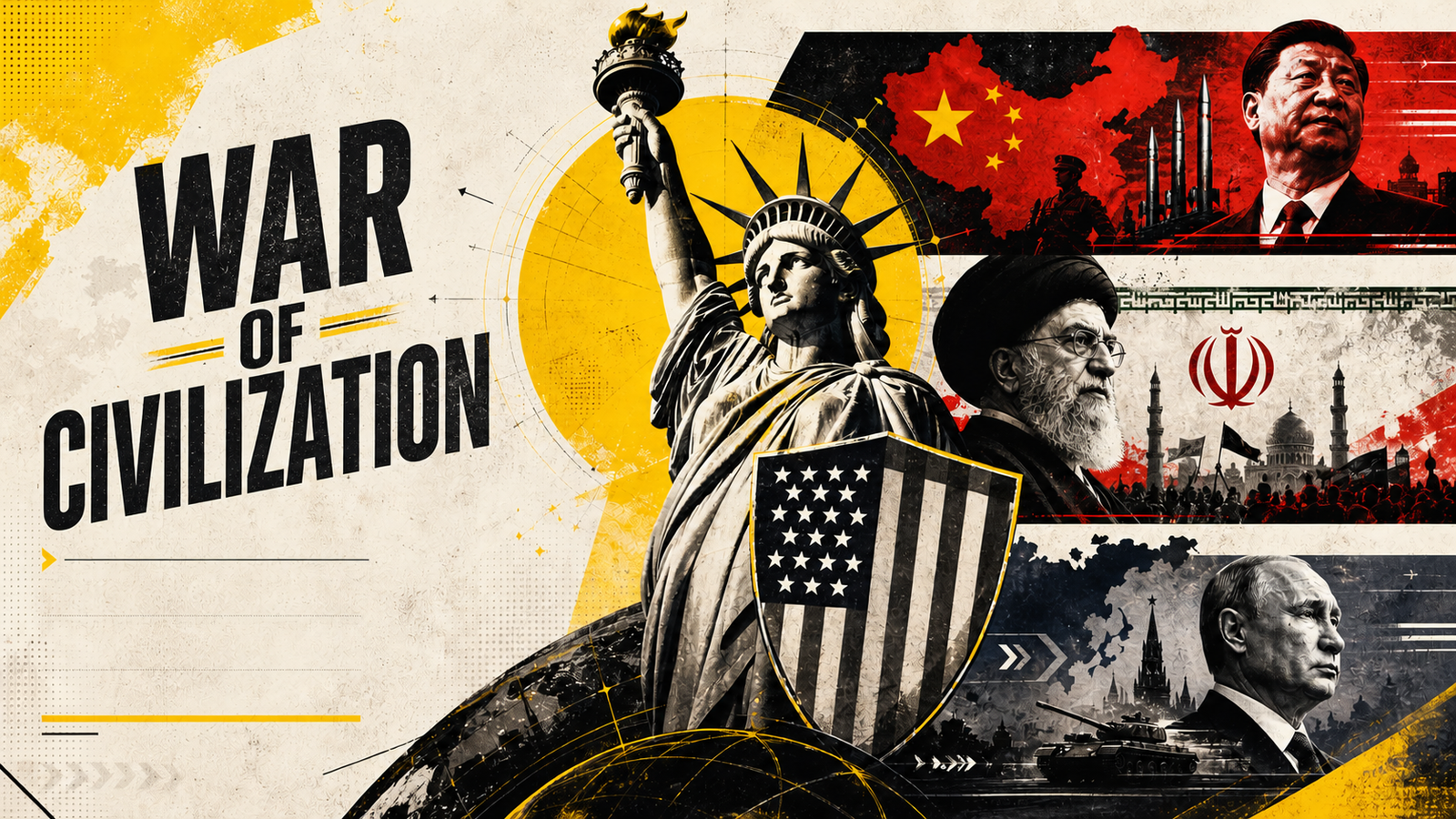
Currently, the United States has three major competitors: China, Russia, and Iran but each rivalry is different in nature.
The competition with China is not primarily ideological or about communism, but rather about its rapidly growing economy and technological advancement.
The rivalry with Russia is not only military but also strategic in nature.
Scholars emphasize that long-term dominance is not achieved through economy or technology alone; rather, it is ideology that draws individuals and societies into its sphere of influence.
3. American Dominance and Ideological Power
It is true that the U.S. dollar, technology, and military strength have sustained American dominance for decades, but the real source of influence has been the ideological and intellectual spread of capitalism.
Whether political ideas, cultural values, or economic systems all stem from this ideological foundation.
Soviet communism once influenced half the world, but eventually that ideology collapsed and became limited in scope.
4. Iran and the U.S.: A Different Kind of Conflict
If we focus on the core issue, America’s hostility toward China and Russia is not as deep as its conflict with Iran.
Iran’s economy is weaker, and its military power does not match that of the United States, yet in the recent war (2026), the damage inflicted by Iran has been unusually significant for the U.S.
The real issue here is not power, but ideology and civilization.
5. Civilizational Clash and Ideological War
The conflict between the United States and Iran is, in essence, a clash of civilizations.
It is not merely a war over geography, resources, or politics, but an ideological struggle.
Iran’s foundation, laid by Imam Khomeini, is based on the concept of “pure Muhammadan Islam,” which has endured despite decades of sacrifices, sanctions, and crises.
6. Narrative, Media, and Trump’s Politics
Statements by Trump, even if informal, can be seen not just as emotional reactions but as part of a social media strategy.
Market fluctuations and public reactions indicate that such statements have real impact.
For example, when Trump once tweeted that he could “destroy an entire civilization in a day,” it clearly reflects the perception that this is a conflict between civilizations.
7. Iran’s Unique Position
Other countries like Cuba or North Korea also oppose the United States, but the approach toward Iran is different.
This is due to the Islamic civilization it represents—revived and promoted by Imam Khomeini in the 20th century. This civilization:
Challenges global powers
Inspires the oppressed to resist
Advocates for a just global order
8. Ideological Foundations: From Karbala to Mahdism
This ideological framework is rooted in concepts such as Karbala and Mahdism, which are also reflected in recent wartime rhetoric from U.S. officials.
This is not a temporary conflict, but a long-term ideological struggle in which:
There is no permanent ceasefire
Nor any easy reconciliation
9. The Outcome: Who Will Prevail?
The outcome of this struggle can only be one: the dominance of one civilization over another.
It is often presented as a firm belief that a divine civilization will ultimately prevail but this path demands great sacrifices.
10. Conclusion
The confrontation between the United States and Iran is not about borders, resources, or geography.
It is a fundamental clash between intellect and ignorance, ideology and materialism, and ultimately, between civilizations.