Pakistan occupies a unique geography that a few states share. It sits at the junction of South Asia, Central Asia, and Middle East, bordering with Iran, China, Afghanistan, and India. This position of Pakistan has been a burden since history because of its unstable neighbors and unresolved conflicts. However, Pakistan has increasingly sought to reframe its geography as an asset by positioning itself as a facilitator of regional peace, connectivity, and stability. Some of the struggles includes, counterterrorism, internal stabilization efforts, diplomatic engagement in regional conflicts and role in economic connectivity initiatives.
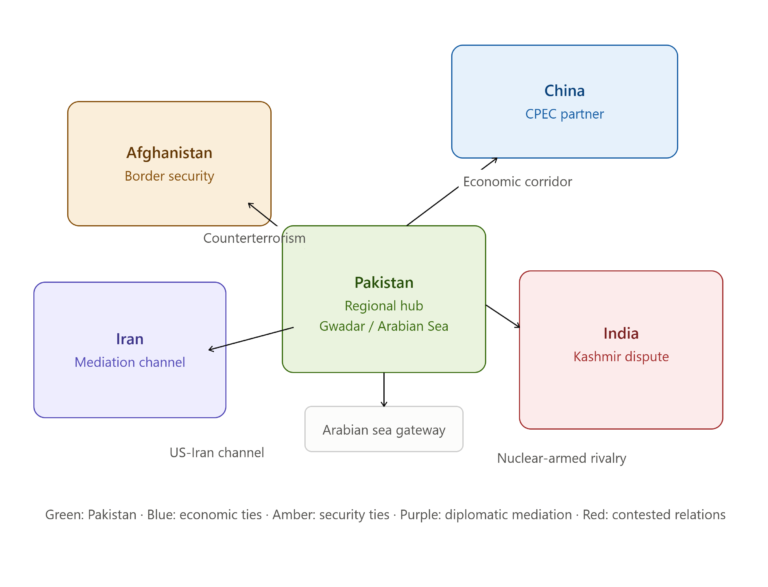
Pakistan’s image was reshaped as a “net regional security stabilizer” by its frontline role in counterterrorism that followed along its western border. Since 2021, Pakistan has adopted a four-pronged “war for stability” to counter the terrorism. This strategy combines the targeted intelligence-based operations and border surveillance. Challenges remain in 2025-2026, including TTP Afghanistan resurgence from Afghanistan, ISKP attacks, and Baloch insurgency targeting CPEC. Pakistan’s retaliatory operation “Ghazab Lil Haq” was launched against the Afghan Taliban regime in February 2026. Pakistan’s counterterrorism efforts are thus central to regional stability and connectivity.
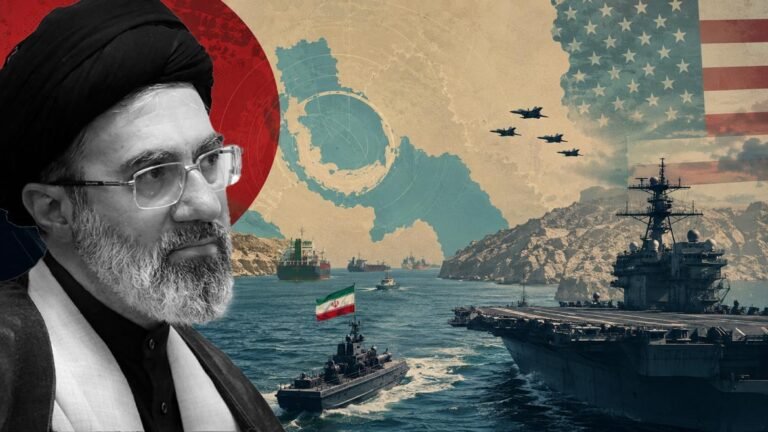
Pakistan’s recent most stabilizing regional role came through its involvement in easing the tensions between Iran and the United States. Islamabad positioned itself as a communication channel between Tehran and Washington, drawing on its long-standing relation with Iran and its historical ties with the US. Whatever the durability of such arrangement, the episode illustrates a broader point that Pakistan has provided the channel to communicate which otherwise was impossible in such serious armed conflict. Pakistan has played a crucial role in de-escalation with contributing to a ceasefire framework and a subsequent memorandum. This shows Pakistan’s efforts to maintain the stability and peace within the region and foster diplomatic relations.
No discussion of Pakistan’s regional role is complete without acknowledging the unresolved Kashmir dispute with India, which remained a central obstacle to normalize Pakistan-India relations over time and, by extension, to deeper regional integration in South Asia. This is the stimulus for periodic military escalations between the two neighbors, and is most acute risk for regional stability because both neighbors are possessing nuclear weapons. Over time, Pakistan has pursued diplomatic engagement through UN and OIC in regards to this dispute, advocating for self-determination of Kashmiris and UNSC resolutions. However, challenges persist to the dialogue processes, due to trust deficit between the two, cross-border tensions and differing narratives. Kashmir issue is the key to unlock cooperation, connectivity and stability, without the resolution, broader regional stability remains constrained.
Pakistan’s geographical location and its access to the hot waters is a plus point for geostrategy and geo-economy. Central Asian landlocked countries are dependent on Pakistan to connect to the world and do trade, which increases its importance in the region.
Economic connectivity, a strong peace building tool
In modern world system, connectivity of the countries with each other is a strategy to maintain peace and avoid the conflict. Economic connectivity is a strong peace-building tool, as an invested argument by Pakistan. Among its neighbors there is China only, with which Pakistan has strong economic relations. The China-Pakistan Economic Corridor (CPEC) is the flagship project of BRI in energy, roads, rail, and ports. Gwadar port gives China direct access to the Arabian Sea and gives Pakistan a trade gateway to Central Asia, Middle East, and Africa. China has helped Pakistan with infrastructure, energy, trade, industry, digital and finance sectors. This connectivity creates economic interdependence which promotes stability and Pakistan act as a bridge for China to access the world. This connectivity can be named as “stability corridor”.
Pakistan’s claim to a constructive regional role rest on real foundations. Decades of counterterrorism efforts, a proven ability to open communication channels between rival powers. Pakistan act as a hub that connects South Asia, Central Asia, China and Gulf states. Yet that potential is tempered by ongoing tensions with India, security concerns along the Afghan border, and domestic economic challenges. For Pakistan to be a durable pillar of regional stability, there is need for consistent and balanced engagement across all neighbors especially, India and Afghanistan.