

The Changing Battlefield of War
In the modern era, wars are not fought only with weapons but also through information, media, and narratives. In today’s world, influencing global public opinion has become no less important than achieving military success.
The Launch of Private Media in Pakistan: A Personal Observation
My late father, who was a photojournalist, was associated with The News (the English-language newspaper of the Jang Group) during the era of General Pervez Musharraf. This was the period when private television channels were beginning in Pakistan and Geo News was being launched. There was an atmosphere of excitement and enthusiasm in the media industry.
In those days, my father used to say that the United States had announced large financial packages for the establishment of private TV channels in Pakistan:
16 million dollars for an English channel,
20 million dollars for an Urdu channel,
and 24 million dollars for local-language channels.
This was around 2002, and it is not difficult to imagine the value of the dollar at that time. Although it is not clear whether this was investment or loans, the fact remains that global powers use media as a strategic tool.
Western Investment in Media
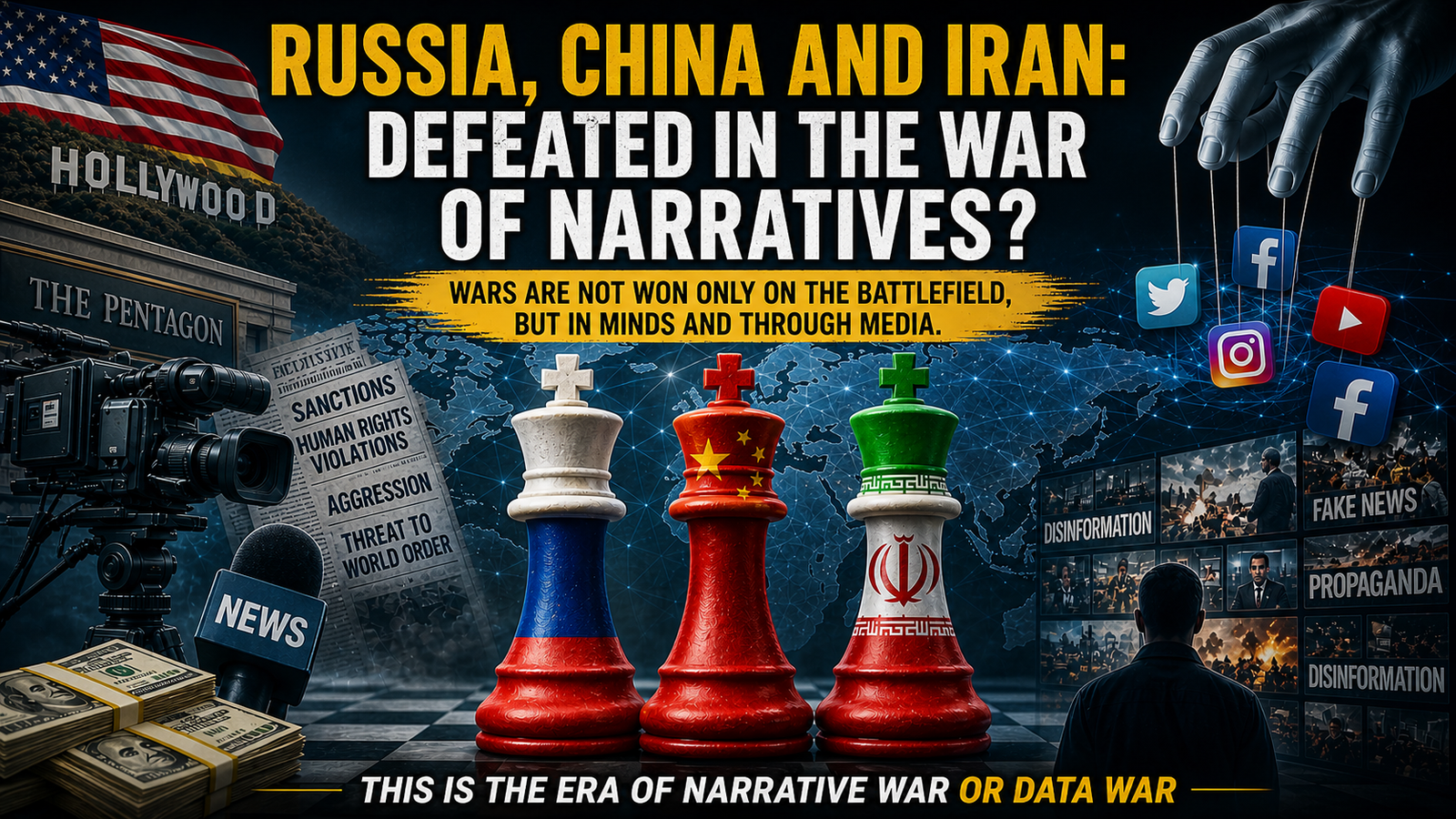
Western powers have worked with great seriousness in the field of media. In 2022, a document surfaced outlining Israel’s social media strategy, explaining how to strengthen its own narrative and weaken opposing narratives.
Similarly, other examples exist. The Pentagon, despite being a defense institution, has a formal office in Hollywood. The technological interests of Israeli intelligence Unit 8200 and platforms like Facebook are also widely discussed topics.
Furthermore, several institutions such as:
USC Shoah Foundation
National Center for Jewish Film
OpenDor Media
have played roles in preserving and strengthening a pro-Israel historical narrative that justifies the establishment of the Israeli state, while weakening alternative narratives.
The English Language: The Key to Global Narrative
It is a reality that English remains the most influential medium of communication globally. Objections to this language are not linguistic but rooted in colonial history. However, its importance for global outreach cannot be denied.
Russia, China, and Iran: Weakness on the Media Front
Russia, China, and Iran are often seen as major challengers to the capitalist system. Hundreds of institutions operate in the West against these countries, not only in local languages but also in English.
For example, there are more than a dozen major organizations focused solely on Iran. A similar situation exists regarding Russia and China.
In contrast, if we look at official or structured English-language media platforms of these three countries, their number is extremely limited. Even if informal platforms are included, this gap remains clearly visible.
Narrative vs Reality
In today’s world, how reality is presented is often more important than reality itself. If one side has battlefield superiority but the opposing side successfully constructs a media narrative, global public opinion tends to accept the narrative rather than the ground truth.
For example, in a conflict, even if facts on the ground favor one side, if media coverage suggests otherwise, global opinion is shaped through news, documentaries, articles, and podcasts.
Data War: The Reality of the Modern Age
Today’s era is a “data war,” where information, algorithms, and digital platforms have become new sources of power. States that utilize these tools effectively are the ones that influence global narratives.
Conclusion: A Necessary Admission
It would not be wrong to say that Russia, China, and Iran lag behind in this media battlefield. It is necessary for these countries to acknowledge this weakness and strengthen their presence in global media, especially in the English language.
Because in today’s world, victory is not achieved only on the battlefield but also in minds and that is what media accomplishes.
Sign in to add a private note to this story.

Related Stories
The Real War: Truth Against Falsehood
Today’s war is not a war of sects. It is not a Shia–Sunni war. It is not a…

You never thought that they would leave.
﴿مَا ظَنَنْتُمْ أَنْ يَخْرُجُوا﴾ This is part of the second verse of Surah Al-Hashr, in which Allah, the…

Freedom – what does it mean?
Freedom – what does it mean? Is freedom something that comes in stages, or is it a definitively…