
The tobacco industry maintained a powerful grip on American society for more than a century—until that grip was finally broken. Its decline offers an important example of how seemingly invincible and deeply entrenched powers can eventually collapse.Glimpses of Its Peak- Annual cigarette consumption per American: more than 4,000 cigarettes- Deaths attributed to smoking: over 100 …
“We Ourselves Have Clothed Monarchy in the Garb of Democracy”Allama Iqbal
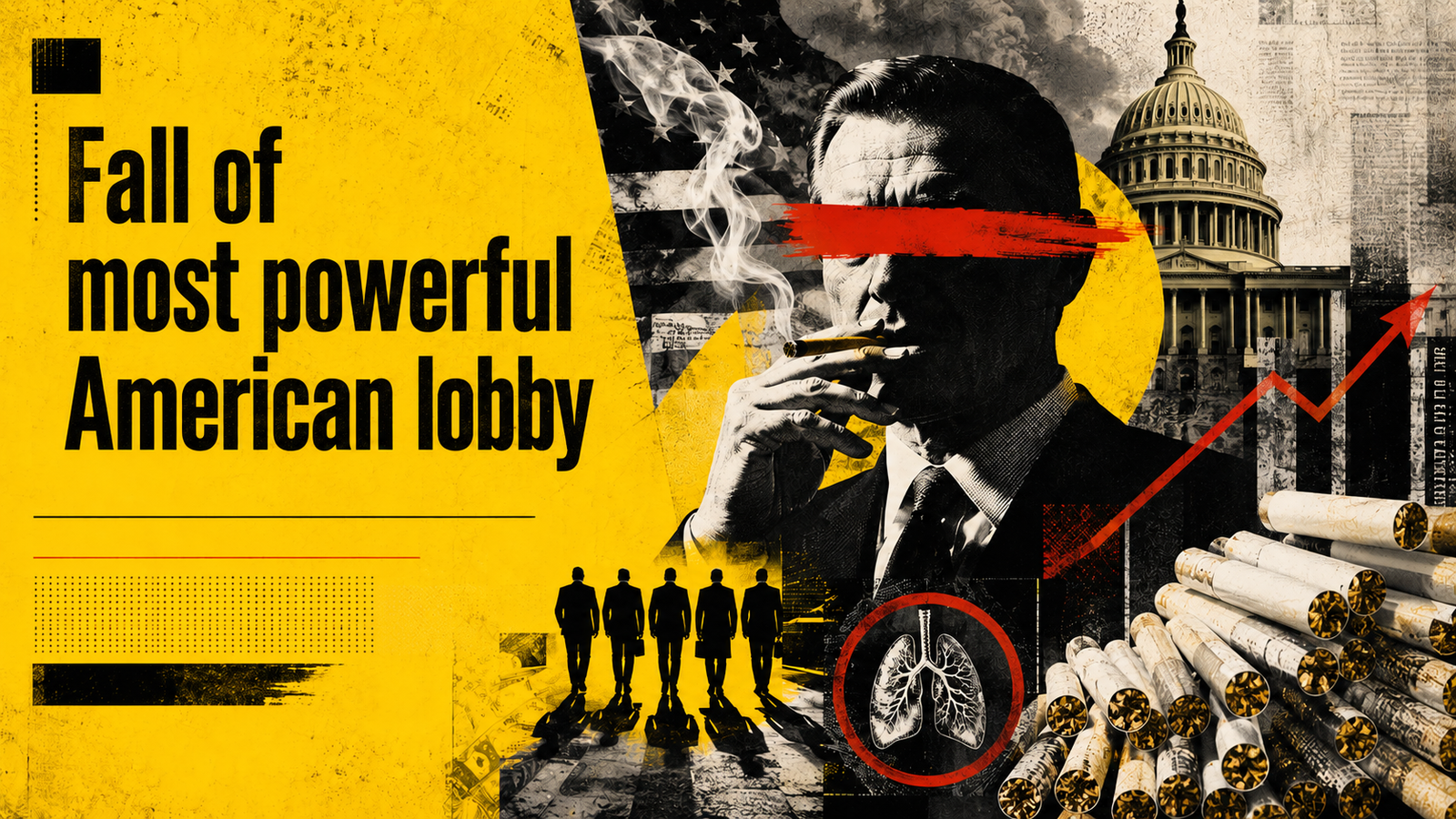
The tobacco industry maintained a powerful grip on American society for more than a century—until that grip was finally broken. Its decline offers an important example of how seemingly invincible and deeply entrenched powers can eventually collapse.
Glimpses of Its Peak
– Annual cigarette consumption per American: more than 4,000 cigarettes
– Deaths attributed to smoking: over 100 million (more than the total deaths of World War II)
– Duration of the lobby’s rise and eventual decline: approximately 100 years
Cigarettes had become so deeply embedded in American culture that it was difficult to find any sphere of life untouched by them. From billboards to films, and even children’s cartoons, smoking was presented as a normal and desirable activity. It was not merely a product; it was a symbol: masculinity for young men, liberation for women, and social status for everyone else.
From the 1920s to the present day, trillions of dollars have been spent on advertising. The popularity of cigarettes was not a natural or spontaneous phenomenon; it was carefully manufactured through deliberate planning.
«At its peak, Americans consumed more than 4,000 cigarettes per person annually—an average of more than half a pack per day.»
Opposition to smoking existed from the very beginning, but it had little meaningful impact. Even in 1964, when the U.S. Surgeon General explicitly declared that cigarettes cause cancer, very little changed in practical terms.
One of the main reasons was the tobacco lobby, which ranks among the most powerful political forces in American history.
Strategy
Four Methods That Kept a Deadly Product Legal for Decades
01 — Manufacturing Doubt
Since the industry could not completely refute the scientific evidence, it funded its own researchers and sought to create uncertainty around the facts. The objective was not to win the debate, but to delay decision-making indefinitely.
02 — Economic Influence
Tobacco money had penetrated deeply into the American economy. Strong ties with senators from tobacco-producing states, advertising agencies, and powerful industrial allies enabled the lobby to block, delay, or quietly reshape regulatory legislation.
03 — Silencing Opponents
When whistleblowers and insiders attempted to expose the truth, the industry sought to undermine their credibility through character assassination, legal threats, and organized campaigns. Creating fear was not a side effect; it was a deliberate strategy.
04 — Redirecting the Debate
Perhaps the most effective tactic was framing smoking not as a public health crisis, but as an issue of personal freedom. By exploiting the deeply rooted American value of individual choice, a public health issue was transformed into a debate about civil liberties.
This lobby was organized, financially powerful, and extraordinarily strategic. In contrast, its opponents were fragmented, under-resourced, and lacking a unified strategy. They were fighting not only against wealth but also against culture itself, because over time smoking had become part of the American identity.
The Real Story
Everything discussed above serves merely as an introduction and a preface.
The central point I wish to make concerns the illusion of democracy—a phenomenon against which Allama Iqbal warned more than a century ago.
The brief history of the tobacco lobby should make it clear to us how public opinion can be shaped and manipulated. Although awareness may eventually emerge, wasting a century of humanity’s progress and sending millions of people to their deaths is not something that can simply be overlooked.
If we reflect on current events, it appears that the deception carried out in the name of public opinion and democracy has been significantly exposed in the aftermath of the Gaza war. Where is public opinion being respected? Where are public demands being honored?
For example, even in the United States today, individuals who oppose a war against Iran—despite not being supporters of the Islamic Revolution in any way—are facing pressure simply for criticizing Trump on this issue. For instance, there has been talk of expelling Dr. Trita Parsi from the United States.
Conclusion
Whether approached through reason or through the guidance of divine law, humanity will ultimately have to return to a heavenly political system, the most complete and perfect manifestation of which is the system of Wilayah (Guardianship) and Imamate.