

In a country like the United States , where millions took to the streets over the war in Gaza, where intense protests erupt over Iran, immigration, racism, and human rights when new details emerged in the highly sensitive Jeffrey Epstein scandal, a case involving the daughters, children, and powerful elites of American society itself, why …
Silent Societies and Exhausted Minds
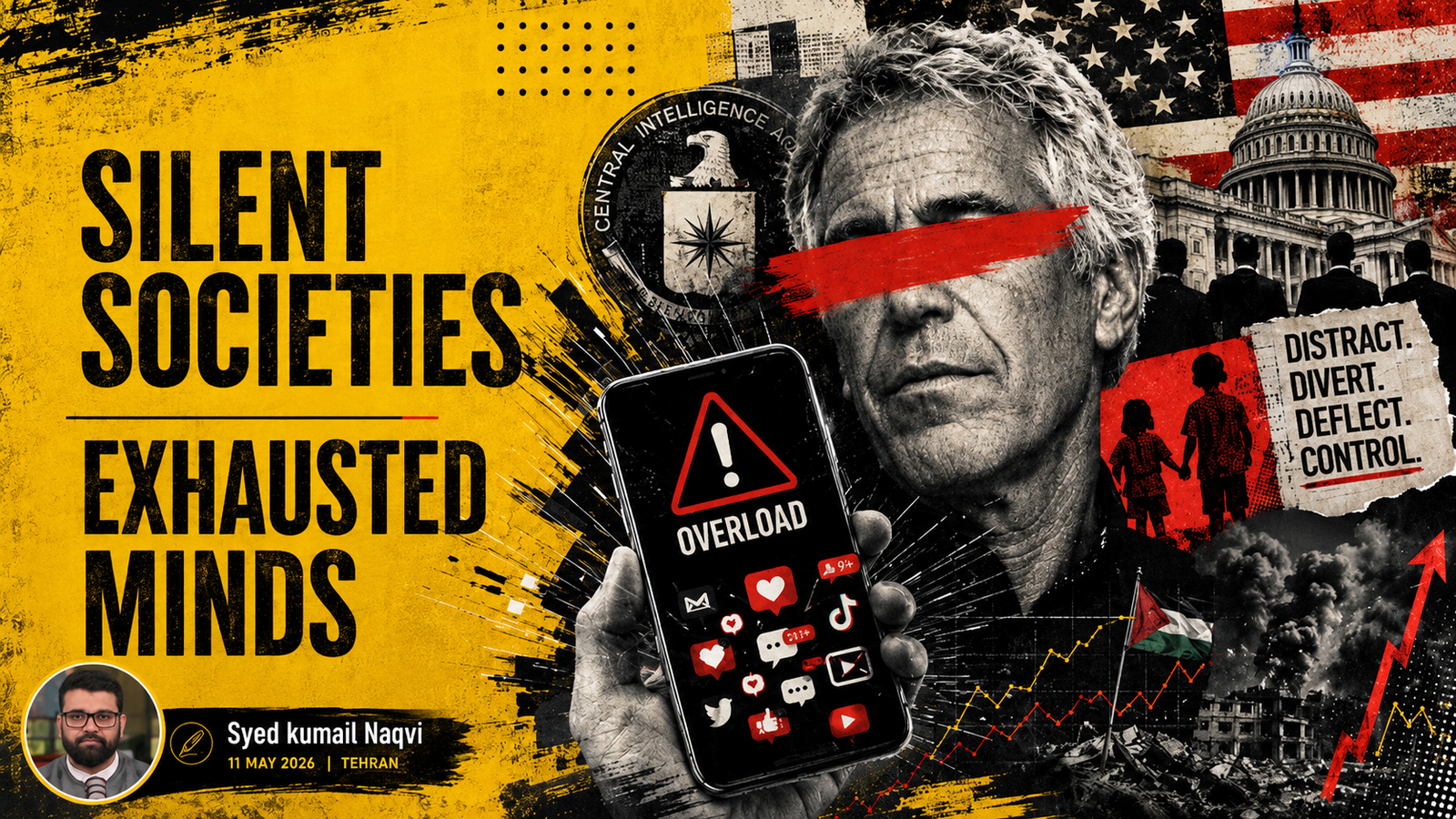
In a country like the United States , where millions took to the streets over the war in Gaza, where intense protests erupt over Iran, immigration, racism, and human rights when new details emerged in the highly sensitive Jeffrey Epstein scandal, a case involving the daughters, children, and powerful elites of American society itself, why did no nationwide public movement emerge?
Why did society grow silent after only a few days of outrage?
This question is not only about the Epstein case. It is a question about human psychology, the influence of media, and the structure of collective consciousness.
Habituation — When Atrocity Becomes Normal
The human brain cannot remain in a constant “alarm mode” forever. If the same trauma, the same injustice, or the same horrifying images repeatedly appear before a person, the mind gradually becomes accustomed to them. In psychology, this is called Habituation the process through which something slowly becomes normal.
What initially feels unbearable eventually begins to lose its emotional impact.
In different parts of the world where children were trained for extremism or terrorism, they were often first exposed to cruelty against animals. Human nature instinctively resists violence the first time it encounters it. The heart recoils, the mind rejects it. But after repeated exposure, those same children become accustomed to such scenes. Eventually, they no longer fear violence they become participants in it.
One of the clearest examples of this today is Gaza.
After October 7, 2023, when some of the most horrifying scenes of the modern era began appearing before the world, global society was in shock. Images that once belonged only to war films suddenly became part of everyday mobile screens.
Even in societies like the United States and Europe, where the Palestinian issue had long been presented through distorted lenses, millions came out in protest.
But then time passed.
The same destroyed buildings.
The same dead children.
The same screams.
The same videos.
And gradually, the human mind became accustomed to them.
This numbness does not emerge suddenly. There is a complete psychological process behind it.
Desensitization — The Death of Sensitivity
Every society considers certain things “normal” and others “abnormal.” But when something abnormal is repeated continuously, displayed over and over again before the collective eye, people gradually begin losing sensitivity toward it.
First, people are shocked.
Then they fall silent.
Then they become accustomed.
For example, in a conservative society, if a particular style of clothing is considered unacceptable, it initially provokes severe backlash. But if the same image is repeated constantly, resistance slowly fades. Eventually, what was once “abnormal” becomes “normal.”
The same principle applies to media, politics, war, violence, and moral scandals.
When a society continuously consumes shock, eventually shock itself becomes entertainment.
Perhaps this is why cases like Epstein — scandals that once could have shaken entire systems today become nothing more than another headline after a few days.
War on Minds — The Battle for Consciousness
Wars are not fought only with weapons.
Some wars are fought for the human mind, consciousness, and attention. And perhaps the most dangerous war of our time is precisely this:
War on Minds
or
War on Truth.
To weaken societies, it is not enough to destroy economies. One must also paralyze people’s ability to think, understand, and reach the truth.
This is where the war to hijack human minds begins.
Flood people with so much information, so much noise, so much content, that they lose the ability to stop and think.
Today’s world of YouTube Shorts, TikTok, and Instagram Reels is built on seconds-long videos, rapid cuts, loud music, and constant dopamine hits designed to capture human psychology.
The question is:
Is this all accidental?
Or is it a carefully engineered strategy?
These platforms were designed around human psychology. Their purpose is not merely entertainment — it is attention capture.
The result is a society trapped in short-term attention spans.
Now, a video longer than a minute feels boring. Reading a long article feels exhausting. Deep reflection on serious issues is becoming almost impossible.
Yet understanding any important truth requires time, silence, attention, and sustained thought.
But once the mind becomes addicted to endless scrolling, it begins losing the capacity for deep thinking.
This is Information Overload.
Drown society in so much information that truth disappears beneath the ocean of content.
Take the Jeffrey Epstein case as an example: millions of pages, thousands of details, endless revelations. But how can a public whose attention span has shrunk to seconds possibly investigate deeply enough to uncover the truth?
Gradually, people emotionally disconnect from important issues.
And that is the success of this war.
There is no longer any need to censor people directly. Simply distract them enough, and they will distance themselves from reality on their own.
Today humanity possesses more information than ever before , but less understanding.
There is endless content, yet wisdom grows increasingly rare.
And perhaps that is the greatest tragedy of our age.
Learned Helplessness — The Psychology of Defeat
Another dangerous stage of this psychological process is Learned Helplessness.
This is the condition in which people repeatedly witness injustice, corruption, and powerful elites escaping accountability until they slowly begin believing:
“Nothing can change.”
Psychologists first explored this concept experimentally, observing that subjects repeatedly exposed to pain or failure eventually stopped trying altogether ,even when escape or change later became possible.
The same thing happens to societies.
When people repeatedly see that powerful individuals escape punishment, scandals disappear, wars continue, protests fail to change policy, and media outlets move on to a new topic every few days, a collective silence begins to emerge.
People still feel anger.
But they stop taking action.
They begin asking:
“What difference will speaking out even make?”
This numbness is not always born from support for injustice. Often, it emerges from psychological exhaustion and repeated disappointment.
This is the stage where societies become emotionally numb.
They still recognize oppression as oppression , but they stop reacting to it.
Perhaps this is exactly what happened with the Epstein case.
People saw the headlines, heard the names, listened to discussions about powerful connections, but already carried a collective conclusion in their minds:
“In the end, nothing will happen.”
And once people lose faith in outcomes, protests slowly become symbolic gestures rather than real movements.
That is why societies do not always need censorship to collapse.
Sometimes it is enough to convince people that their voices are powerless.
Media Complexity — The War of Narratives
Now we arrive at perhaps the most dangerous layer of this entire process:
Media Complexity.
The more the world speaks about media freedom and neutrality, the more obvious it becomes that media is never entirely free.
Most media institutions ultimately promote some narrative, political interest, or worldview aligned with powerful circles.
And often, they do not rely on complete lies — but on “half-truths.”
Because half-truths can be more dangerous than complete falsehoods.
Throughout the world, wherever genuine independent journalism has been attempted, journalists have paid a heavy price: threats, imprisonment, character assassination, and at times, death.
Especially in war zones, the world has witnessed that journalists themselves are no longer safe. This is proof that control over information has become as important as weapons themselves.
But what exactly is Media Complexity?
It refers to the complex structure through which specific analyses, opinions, or narratives are repeated so consistently that they gradually begin to feel like reality itself.
A particular angle is packaged as “facts.” Over time, viewers, readers, and listeners begin accepting that narrative as truth — even though reality may be far more complicated.
This is why information today is no longer simply information. It has become Perception Management.
People no longer see reality itself. They see the version of reality constructed before them.
Look again at the Epstein case.
Numerous connections and questions emerged involving powerful circles, political figures, and international networks. Whether it was Jeffrey Epstein’s relationship with former Israeli Prime Minister Ehud Barak, or allegations surrounding Mossad and American intelligence connections, many analysts discussed these angles extensively.
Yet interestingly, the dominant narrative reaching the public often moved in another direction entirely , with attempts made to associate Epstein instead with Russian intelligence.
Again and again, discussions were redirected toward alternative subjects while the core questions faded into the background.
This is Media Complexity.
Reality does not always need to be hidden completely. One simply has to create enough noise around it, enough competing angles, that ordinary people can no longer reach the central point.
The same pattern appeared during the recent tensions involving the United States, Israel, and Iran. As global energy crises emerged, inflation increased, and fuel prices soared, sections of American media repeatedly promoted one particular phrase:
“Short-term pain for long-term gain.”
The issue is not whether the phrase was right or wrong. The real question is how a specific framing was used to shape public emotions, tolerance, and perception.
Because media does not merely report reality.
It constructs society’s understanding of reality itself.
And when this process continues for years, societies slowly become accustomed to everything.
Oppression begins to feel normal.
Wars begin to feel ordinary.
Scandals disappear after a few days of headlines.
And humanity’s moral sensitivity slowly fades away.
—
Conclusion — The Era of Silent Wars
This is the background that helps explain why even the most horrifying scandals often fail to produce meaningful public reactions.
Because reacting requires more than information.
It requires independent consciousness, deep attention, and the ability to reach truth itself.
And when the human mind remains trapped inside distraction, information overload, and media narratives, people eventually stop feeling reality — even while watching it unfold before their eyes.
And perhaps that is the quietest, and most dangerous, war of our age.